

Category: Building Community

Association of Washington Tribes: Leadership, Advocacy and What’s Ahead

For the first time in its history, the Association of Washington Tribes (AWT) has a full-time Executive Director, demonstrating tribal leaders’ commitment to sustained and coordinated representation of tribes in Washington state.

Founded in 1998, the AWT has long served as a forum for tribes to advocate for tribal sovereignty and treaty rights. The organization advances the principles of the Centennial Accord, which established a formal government-to-government relationship between the State of Washington and federally recognized tribes.

AWT’s Executive Director is Patrick DePoe, a Makah tribal member with deep experience in tribal and state government. He previously served on the executive team at the Washington State Department of Natural Resources and spent six years as an elected member of the Makah Tribal Council, where he led tribal coordination with state and federal agencies on climate resilience and habitat restoration.

In his new role, DePoe is focused on strengthening relationships between tribes and state leaders and creating opportunities for meaningful engagement around key issues.

“I’m focused on making conversations happen,” explains DePoe.
That approach was evident last December, when nearly 200 people attended a two-day AWT meeting that brought together tribal leaders, Washington state legislators, department directors, and many others to discuss tribal perspectives on priority areas, including natural resources, healthcare, social services and the state’s budget.

DePoe credits the strong turnout in large part to tribal leaders, particularly AWT Chair and Lummi Nation Tribal Chair, Tony Hillaire.

“Chairman Hillaire does an excellent job of speaking with tribal leaders across the state about the importance of tribes coming together,” says DePoe.

He is equally appreciative of AWT Vice Chair and Chair of the Tulalip Tribes, Teri Gobin.

“I am incredibly grateful to the Tulalip Tribes for hosting the AWT meeting for tribal leaders and legislators and to Chair Gobin for giving so much to support AWT’s next chapter,” he says.

The next AWT meeting will take place during the Affiliated Tribes of Northwest Indians Winter Convention in early February. DePoe also plans to convene another AWT meeting later this year and facilitate smaller discussions between tribal leaders and state elected officials.

Despite ongoing challenges, including state budget shortfalls and the federal government’s trust responsibilities, DePoe remains optimistic.
“Every one of our tribal nations has power, he says. “When we come together, there’s so much we can accomplish.”
Strong Tribal Economies Benefit All of Washington

An economic impact study released this week shows that Washington’s 29 federally recognized tribes generated more than $7.4 billion in gross state product in 2023 alone—up from $6.6 billion in 2020.

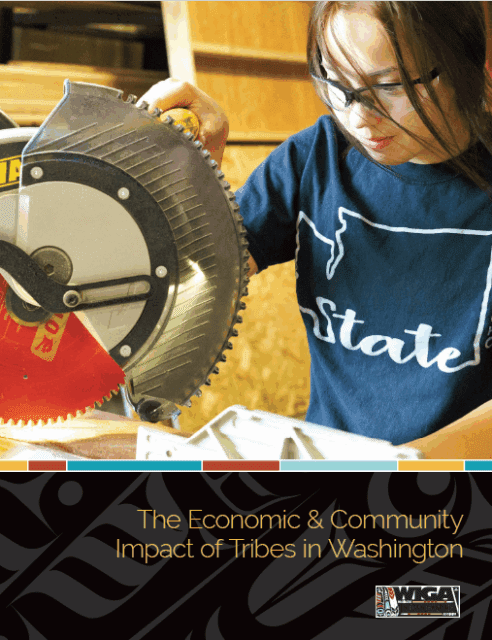
Commissioned by the Washington Indian Gaming Association (WIGA) and authored by economists Amy Besaw Medford and Jonathan B. Taylor, The Economic & Community Benefits of Tribes in Washington explains how tribal economies—supported by gaming and a growing and diverse range of businesses—are investing in essential services, creating jobs and supporting families and communities across the state.

“We’re witnessing a remarkable transformation in Indian Country,” said Jonathan Taylor, co-author of the report. “Tribes in Washington have gone from having very few jobs on reservations to being leading employers. Today, tribes together are the state’s 8th largest employer.”

Key Tribal Economic Impacts:

  • $3.9 billion in wages and benefits
  • $1.5 billion in state and local taxes
  • 52,000+ jobs supported statewide—most held by non-Indian employees

This growth is having a powerful impact on the quality of life in the state. Since 1990, the real income of American Indians on reservations in Washington has grown by 59%, college degrees have doubled, and family poverty has dropped by 46%. But significant challenges remain: Native households still face poverty at four times the statewide average.

“While I’m proud of Washington tribes’ success, we have a long way to go,” said Ron Allen, Chairman of the Jamestown S’Klallam Tribe, who also chairs WIGA. “It’s important for the public to understand the impact tribal revenues have on our communities. These flexible revenues are a critical tool for our self-reliance.”

As tribes continue to drive economic growth and social progress, Washingtonians across the state stand to benefit for generations to come.

Evergreen Native Pathways Students Learn Through an Indigenous Lens

Education plays a vital role in advancing the lives of tribal members and their communities. Through education, today’s native students will become tomorrow’s tribal leaders. Yet the historical relationship between Native Americans and the U.S. education system has left a legacy of mistrust. Recognizing this, a growing number of educational institutions are offering programs aimed at supporting native students’ success by emphasizing tribal culture and identity. One such example is the Evergreen College’s Native Pathways Program (NPP).

For more than 30 years, NPP has supported Native American students in higher education by offering a degree program for students interested in “expanding knowledge through an Indigenous lens.”

Students participate in a cohort model of learning—a community working together towards a bachelor’s degree. The core academic curriculum is focused on research, writing, and critical thinking with an emphasis on leadership, building community, and cultivating Indigenous values. NPP uses works by Indigenous authors and scholars, engages in place-based learning that tells the stories of the lands we live on, and provides lessons centered on Indigenous cultural knowledge. The program includes diverse course offerings such as Rooted: Legacies of Food Justice; History of Federal Indian Law and Policy; and Native American Film Representation.

The NPP operates at several locations, including the main Evergreen campus in Olympia, the Longhouse at Peninsula Community College, and a new online/hybrid option, called “Salish Sea,” which allows the program to reach students who would otherwise be unable to participate.

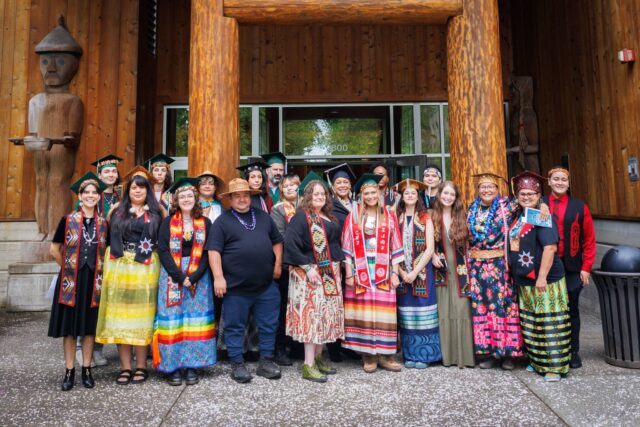
The Native Pathways Program celebrates its class of 2024 with a graduation ceremony on Sat., Jun. 15, 2024.

Learn more on the Native Pathways Program website.